
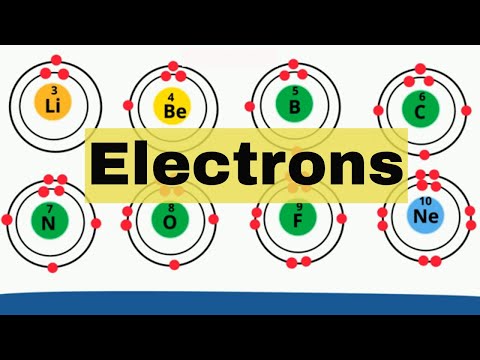
The number of valence electrons in all the weather of group-13 is three. The electron configuration of boron atom exhibits that there are three electrons in the final orbit of the boron. The valence electrons of all the weather of group-13 including boron are three. The electron configuration of nitrogen shows that there are two electrons in the first orbit and a total of five electrons within the second orbit.
Valence electrons or outer-shell electrons are indicative of an atom’s reactivity. The presence of eight electrons within the valence shell of an atom imparts stability to that particular atom. To attain stability, atoms transfer or share electrons within themselves in such a way that they can fulfill the octet rule and attain noble gas configuration. Water is neither purely ionic nor purely covalent. But the electrons aren’t shared equally, as indicated by the Lewis construction on the proper on this determine.
Definition Of Valence Electron
Do take observe that periodic tables differ from country to country. So, please check that you’re using the correct, updated one so as to keep away from confusion. Include your email tackle to get a message when this question is answered. The order that electrons are placed into shells is summarized by this chart.
According to Neils Bohr, electrons are organized across the nucleus in vitality orbits or shells. The electrons present in the outermost orbit are known as valence electrons or outer-shell electrons. Elements possessing eight electrons in their outer orbit or valence orbit are stated to possess octet configuration. An component behaves as a non-metal when the variety of valence electrons in its atom is greater than 4. The non-metals are a bad conductor of electricity. The three well-known examples of the insulator are nitrogen, sulphur and Neon.
In common, atoms are most stable and least reactive when their outermost electron shell is full. Inner-shell electrons usually are not involved instantly in the element’s reactivity or within the formation of compounds. As the quantity of protons improve, the efficient nuclear charge must improve. But the core electrons don’t change in quantity ga valence electrons until you get to the next row on the periodic table, after the previous noble gas goalpost has been met. Those core electrons really feel the total drive of the nucleus, but they are usually not enough to utterly mask the complete optimistic cost.
- Another instance is oxygen, it is a impartial atom and it’s present in group 6 of the periodic table, this insinuates that oxygen has 6 valence electrons.
- But the core electrons don’t change in quantity till you get to the following row on the periodic table, after the previous noble gasoline goalpost has been met.
- Valence electrons could be found by determining the digital configurations of components.
- When the difference is bigger than 1.8, the bond is assumed to beionic.
- The variety of valence electrons for molecules may be calculated by adding the valence electrons of all of the atoms that form that respective molecule.
- Information that could presumably be included, but just isn’t restricted to, are component name, atomic numbers, mass numbers or weights, frequent oxidation numbers.
Which of the following metals has the strongest metallic bonding? Sodium, lithium, beryllium, magnesium, or aluminum. Use of communications and information methods that are familiar to … Even in an isolated atom the electron is delocalised across a quantity of order an Angstrom radius from the atom.
The Bonding Abstract
For instance, sodium, atomic number 11, has eleven electrons and an electron configuration of 2,eight,1. There is 1 electron in the outermost shell, so sodium has one valence electron. In this problem, we did not find yourself using the second relationship between the variety of electron shells and the bond power.
Sodium needs to lose 1 electron to realize octet . Number of electrons in a valence shell can differ from 1 to eight . The maximum variety of electrons in a valence shell can be eight. Remaining shells can accomodate eight electrons each . After accommodating 8 electrons, the remaining electrons transfer to the subsequent shell and so forth. Also, we know that elements of groups 15, sixteen, 17 together with Hydrogen is non – steel.
The strongest bond is the one that has the strongest attractions between the particles. There are two key characteristics that can have an effect on the power of the sights from steel to metallic. First, the extra valence electrons that a steel has, the stronger the bond. The extra electrons will add to the general attractive forces appearing on the positive ions. The other relationship that would come into play is that, in general, extra electron shells means a weaker bond, although there are many exceptions to this pattern. We have used a strong subject S-matrix theory to analyse the ionisation of inner-valence electrons of the nitrogen molecule in an intense laser pulse.
How Is Valency Of An Element Determined?
Valency is defined as the entire variety of electrons an atom can lose, gain, or share at the time of bond formation to get a steady digital configuration i.e. to complete an octet. The valency of an atom could be variable in several compounds or chemical reactions because of the totally different bonding circumstances. Most of the time valency varies/changes because of change in oxidation and discount states.
Therefore, the ironelectron configurationwill be 1s2 2s2 2p6 3s2 3p6 3d6 4s2. The valence electron is the one liable for the chemical properties of the atom. Although the number of shells rises as we journey down a bunch, the variety of valence electrons stays fixed. The shells are named ‘K’, ‘L’, ‘M’, ‘N’ and so on. The different varieties of atoms come together and form components. In this tutorial, we find out about valence electrons, what they’re, and why they’re vital.
Recent Comments